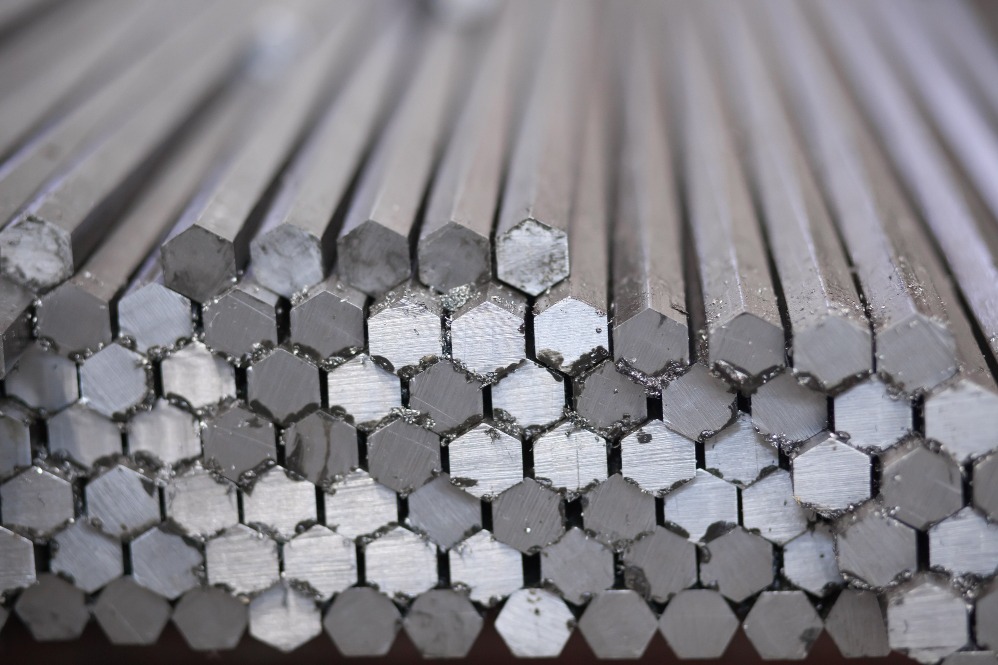
Aluminium hexagonal rods are useful for components that require flat gripping surfaces while benefiting from aluminium’s low weight and corrosion resistance. They can reduce the number of machining operations needed for connectors, spacers, fasteners and instrument parts.
For industrial buyers comparing aluminium hexagonal rod dealers in Madurai, the key question is whether the available stock will improve total production efficiency not merely whether it has the lowest purchase rate.
Applications of Aluminium Hex Rods
Hexagonal stock may be machined into:
- Lightweight nuts
- Spacers and standoffs
- Adaptors
- Electrical components
- Instrument parts
- Decorative fittings
- Control-system components
- Connectors
- Special fasteners
The flats can provide convenient tool engagement and workholding. Starting with a hexagonal profile also avoids milling flats onto round stock in many designs.
Measure Across the Flats
Hex rod sizes should be stated across opposite flat surfaces unless the project specification uses another convention. Buyers should avoid vague descriptions such as “approximately 20 mm hex.”
The enquiry should clarify:
- Across-flats dimension
- Length
- Alloy
- Temper
- Quantity
- Tolerance
- Surface finish
- Cut-piece requirement
When across-corners clearance matters, include this in the component drawing.
Decide Whether Hex Stock Really Saves Money
Hexagonal rod can reduce machining time, but it is not automatically the most economical choice. The final component geometry and production volume should guide the decision.
Compare the cost of:
- Purchasing hexagonal material
- Turning or drilling the main features
- Cutting and facing each component
- Milling flats from round stock
- Material removed as scrap
- Additional setups and inspection
For repeated production, eliminating one milling operation can produce meaningful savings. For a small custom batch, locally available round stock may sometimes be more practical.
Check Alloy Suitability
Aluminium alloys vary in strength, machinability, corrosion resistance, forming response and finishing characteristics. A decorative fitting may prioritise surface appearance, while a mechanical connector may require higher strength.
Confirm whether the component will be:
- Anodised
- Welded
- Threaded
- Exposed outdoors
- Electrically conductive
- Subjected to repeated loading
- Used near chemicals
- Required to meet a specific standard
The approved alloy should be shown on the purchase order. Substitution requires technical review.
Examine Corners and Straightness
Damaged corners can affect appearance, workholding and the finished across-flats dimension. Long bars should also be checked for excessive bend or twist.
Surface scratches may be removed during full machining, but they can remain visible when the original flats form part of the finished product. Packaging and transport therefore matter for decorative components.
Improve Material Yield
Calculate the number of parts obtainable from each rod while allowing for saw kerf, facing and gripping. Coordinate cut lengths with the machining team so the stock is neither unnecessarily long nor too short for secure holding.
For multiple component sizes, a nesting or cutting plan can reduce offcuts. Usable remnants should be identified and stored by alloy and size rather than mixed with general scrap.
Finding a Suitable Madurai Dealer
A dependable source should confirm the measurement convention, alloy, temper and available length before accepting the order. Buyers should also ask about cut pieces, quantity consistency and material documents where required.
Sun Steel Traders supplies aluminium hexagonal rods and other metal products for Madurai’s fabrication and industrial market. A detailed bill of materials helps the provider check relevant sizes and organise supply.
Choosing hexagonal stock can simplify manufacturing when the component design uses external flats. Accurate measurement, appropriate alloy selection and yield planning allow procurement teams to turn that geometric advantage into lower production time and more consistent finished parts.
Keywords